
We usually look at Bitcoin through fiat prices... but what if the real problem is the currency itself?
In this opinion piece, Don Kruger, Head of Platform at EasyEquities, takes a measured, analytical look at Bitcoin’s true role in a modern portfolio. Moving beyond the hype, he explores where Bitcoin has proven effective under pressure, where its limitations are exposed, and why the future of finance might require us to turn our definition of value on its head.
Summary
-
Hedge vs. Safe Haven: The asset has proven exceptional at protecting purchasing power in emerging markets facing fiat collapse, but it consistently mirrors tech stocks during sudden market panics.
-
Strategic Allocation: A small, calculated exposure remains highly relevant for modern portfolios, provided investors understand exactly what they are and aren't getting.
Bitcoin Protects Against Collapsing Currencies but Does Not Behave as a Safe Haven
Bitcoin has long attracted a compelling narrative: that it serves as digital gold—a decentralised, finite-supply asset capable of protecting wealth when fiat monetary systems buckle. A decade of data now allows us to test this thesis with some rigour. The evidence, drawn from peer-reviewed correlation studies, on-chain adoption metrics, and real-world currency crises across Turkey, Argentina, Nigeria, and Egypt, points to a nuanced verdict: Bitcoin behaves as an effective hedge against monetary collapse, yet consistently fails the stricter test of being a safe haven asset during acute market stress.
The distinction matters enormously for investors and policymakers alike. A hedge is an asset that is uncorrelated or negatively correlated with another asset on average over time. A safe haven must go further—it must be uncorrelated or negatively correlated specifically during periods of extreme market distress, preserving capital precisely when other assets are falling. Gold typically satisfies both definitions. Bitcoin, as this article argues, satisfies only the first.
The Monetary Collapse Hedge: Evidence from Collapsing Currencies
The strongest case for Bitcoin as a hedge emerges not from developed-market data, but from countries where fiat currencies have materially devalued over the past decade. The Turkish lira has lost roughly 85% of its value against the US dollar since 2015, with the sharpest moves occurring after the 2018 currency crisis and the unorthodox interest-rate cuts of 2021–2023. The Argentine peso has depreciated by approximately 98% over the same window, punctuated by serial devaluations and capital controls. The Nigerian naira and Egyptian pound have both suffered multiple forced devaluations, with the naira’s parallel-market rate diverging dramatically from official pegs.
In each case, Bitcoin adoption surged in tandem with currency weakness. Chainalysis’s 2025 Global Crypto Adoption Index documents this pattern quantitatively.[1] Turkey leads global crypto ownership growth, with a 27.1% increase in a single year, and the adoption curve steepened precisely during quarters of peak lira volatility.[2] In Nigeria, a March 2025 naira devaluation triggered a measurable spike in centralised exchange volume. Argentina’s crypto trading volume reached $91.1 billion between 2023 and 2024, surpassing Brazil despite having a fraction of the population.
Critically, Bitcoin’s performance measured in these collapsing local currencies has been extraordinary. While BTC appreciated roughly 60% against the US dollar during 2024, it appreciated approximately 90% against the Argentine peso and over 200% against the Turkish lira.[3] This outperformance relative to devaluing fiat is the core of the hedge thesis: Bitcoin’s fixed supply and borderless liquidity make it a natural beneficiary when citizens lose confidence in their domestic monetary authority. The negative correlation between local currency strength and Bitcoin adoption in these markets is not speculative—it is observable and persistent.
The Correlation Evidence: What the Numbers Show
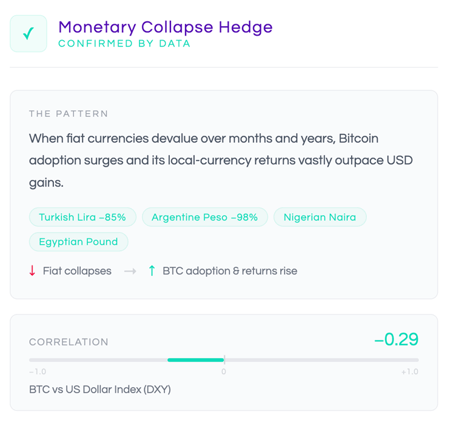
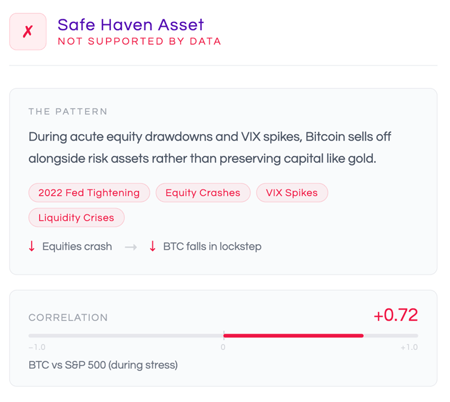
Formal correlation analysis reinforces the narrative. A 2025 rolling-window DCC-GARCH study published in Global Business Review examined Bitcoin and gold’s dynamic correlations with equity markets and the US dollar during multiple crisis periods.[4] The findings were unambiguous in their duality: Bitcoin exhibited a –0.29 correlation with the US Dollar Index by 2025, suggesting a meaningful partial hedge against dollar weakness and, by extension, against the monetary expansion that drives fiat devaluation. At the same time, Bitcoin maintained a 0.72 correlation with the S&P 500—a level that thoroughly disqualifies it as a safe haven during equity sell-offs.
Gold, by contrast, consistently demonstrated low or negative correlations with equities during drawdown periods, fulfilling its traditional safe haven role. The same study concluded that gold remains a superior safe haven asset, while Bitcoin’s safe haven properties were characterised as “weak”—though it showed utility as a portfolio diversifier and long-term hedge.[5]
A separate peer-reviewed study in Accounting & Finance found that Bitcoin’s inflation-hedging capability is time-horizon dependent: it functions as a hedge over longer periods but fails during short-term inflationary spikes.[6] This temporal asymmetry is crucial. Monetary collapses unfold over months and years—precisely the horizon over which Bitcoin’s hedge properties are strongest. Safe haven events, however, are acute: a two-week equity crash, a sudden liquidity crisis. Bitcoin’s high beta to risk sentiment means it tends to sell off alongside equities in precisely these moments.
The Safe Haven Failure: Stress-Testing Bitcoin
The distinction between hedge and safe haven crystallises during specific market episodes. During the aggressive Federal Reserve tightening cycle of 2022–2023, Bitcoin fell roughly 65% from its November 2021 peak, tracking high-growth technology stocks almost in lockstep. Gold, meanwhile, held its value and subsequently rallied to new all-time highs. When the Fed delivered a rate cut in December 2025, Bitcoin traded flat near $92,000 rather than rallying—a response that underscored its sensitivity to monetary-policy expectations rather than its independence from them.
The pattern is consistent across crises. During acute equity drawdowns, Bitcoin’s correlation with risk assets rises, not falls. Portfolio managers looking for capital preservation during a VIX spike find Bitcoin wanting: its liquidity profile, 24/7 trading, and retail-heavy ownership base make it susceptible to rapid de-leveraging during exactly the moments when a safe haven asset should provide stability.
There is a partial counterpoint. During the geopolitical escalations surrounding the Russia–Ukraine and Israel–Palestine conflicts, Bitcoin saw trading volume surges as investors in affected regions sought alternatives to disrupted banking systems. But elevated volume is not the same as price stability. A safe haven must hold or gain value during stress—Bitcoin’s price behaviour during these events was volatile and directionally inconsistent.
Synthesis: A Maturing but Conditional Asset
The evidence supports a clear conclusion. Bitcoin is an effective hedge against the slow-motion erosion of fiat purchasing power and, more dramatically, against outright monetary collapse. Citizens in Turkey, Argentina, Nigeria, and Egypt have demonstrated this with their wallets—adoption data, trading volumes, and local-currency returns all confirm that Bitcoin serves as a release valve when domestic monetary policy fails.
However, Bitcoin does not behave as a safe haven in the classical sense. Its high correlation with equities during market stress, its sensitivity to interest rate expectations, and its price volatility during acute crises all disqualify it from the role that gold has occupied for centuries. The 2024–2025 macro environment—with spot ETF inflows, institutional adoption, and reduced correlation to high-risk assets during some stress periods—suggests Bitcoin is gradually maturing toward more stable behaviour. But gradually is the operative word. At present, a 0.72 correlation with the S&P 500 is fundamentally incompatible with safe haven status.
For portfolio construction, the implication is practical: a modest allocation to Bitcoin (research suggests 1–5%) can enhance risk-adjusted returns and provide genuine hedging value against monetary debasement, particularly for investors with exposure to weakening currencies. But it should not be relied upon to preserve capital during a sharp equity correction. For that, gold and sovereign bonds remain superior.
Bitcoin may yet earn its place as digital gold. The trajectory is encouraging. But the data, as of early 2026, tells us it is only halfway there.
The data tells us Bitcoin is still maturing, but its steady rise ultimately challenges our fundamental perception of value. For a century, we have been conditioned to use sovereign currency as our absolute baseline. We measure Bitcoin's success by how much fiat it commands, just as citizens in collapsing economies watch the price of bread skyrocket. But value is relative. Future generations may look back at this era as a transition phase—the moment humanity slowly stopped asking "How much money is this Bitcoin worth?" and started asking, "How much real value is left in this money?

Don Kruger - Head of Platform
[1]Chainalysis (2025). The 2025 Global Crypto Adoption Index.
[2]Chainalysis (2025). Crypto Adoption in MENA 2025: Crisis, Adaptation, and Growth.
[3]CryptoPotato (2024). Bitcoin Hit ATH in Nigeria, Argentina, and Turkey Amid Raging Inflation.
[4]Kumar, A.S., Mohan, M. & Niveditha, P.S. (2025). Assessing Bitcoin and Gold as Safe Havens Amid Global Uncertainties: A Rolling Window DCC-GARCH Analysis. Global Business Review.
[5]Tandfonline (2025). Can Bitcoin and Gold Have Dynamic Hedging and Safe Haven Capabilities Against BRICS Plus Stock Market Indices During Global Crises? Emerging Markets Finance and Trade, Vol. 61, No. 12.
[6]Smales, L. (2024). Cryptocurrency as an alternative inflation hedge? Accounting & Finance.









Any opinions, news, research, reports, analyses, prices, or other information contained within this research is provided by an employee of EasyEquities an authorised FSP (FSP no 22588) as general market commentary and does not constitute investment advice for the purposes of the Financial Advisory and Intermediary Services Act, 2002. First World Trader (Pty) Ltd t/a EasyEquities (“EasyEquities”) does not warrant the correctness, accuracy, timeliness, reliability or completeness of any information (i) contained within this research and (ii) received from third party data providers. You must rely solely upon your own judgment in all aspects of your investment and/or trading decisions and all investments and/or trades are made at your own risk. EasyEquities (including any of their employees) will not accept any liability for any direct or indirect loss or damage, including without limitation, any loss of profit, which may arise directly or indirectly from use of or reliance on the market commentary. The content contained within is subject to change at any time without notice.
Search all articles
Posts by topic
- Market News & Events
- Easy Community
- Education
- Dividends Update
- Exchange Traded Funds (ETFs)
- Property Investing
- Managed Bundles
- USD Wallet
- Retirement Annuity (RA)
- Cryptocurrency
- Tax Free Savings Account (TFSA)
- International Investing
- Unit Trusts
- New to Investing
- Artificial Intelligence
- EasyProtect
- EasyCredit
- Shares
- Government Bonds
- New Listings