
We map the 20-odd companies behind every AI chip, and where the overlooked opportunity actually sits. More from EasyAssetManagement.
Part of our thematic investing series, following our webinar and our look at commodities. This instalment covers the manufacturing chain behind artificial intelligence, and why it matters more than the headline names.
If you hold an AI-themed ETF, you probably own Nvidia. But Nvidia does not manufacture a single chip. Neither does Apple, AMD, or most of the companies whose names end up on the box. The company getting the attention is often the smallest part of the value chain, and that is where the opportunity most investors overlook actually sits.
At EasyAssetManagement, we treat AI as a stack, not a single trade:
- Apps and models at the top
- Data centres they run in
- Chips inside those data centres
- A global manufacturing chain most people never see, underneath all of it
Hundreds of billions of dollars are moving through this chain. Understanding where that money goes matters more than simply picking the obvious name.
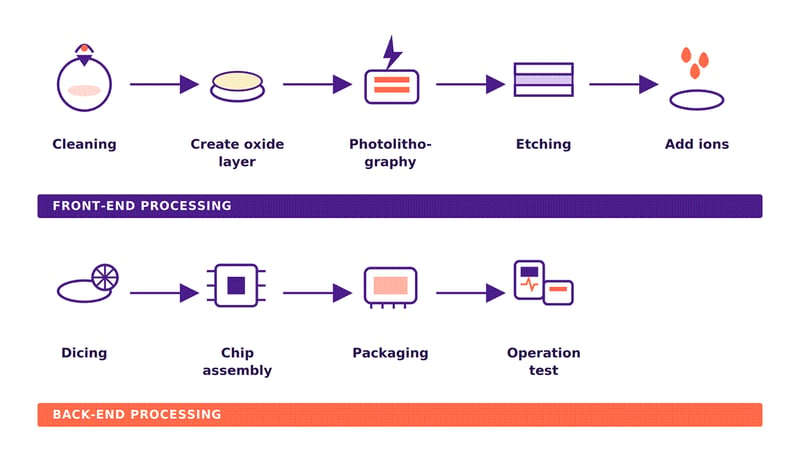
The chip manufacturing chain, front-end to back-end
A Chip Passes Through More Companies Than You'd Guess
Materials. It starts with silicon, refined from quartz to extreme purity (Shin-Etsu reports 99.99% purity for its semiconductor-grade material) and grown into flawless crystal wafers. Two Japanese firms, Shin-Etsu and SUMCO, dominate this stage. Neither will show up in an AI headline, but without them nothing further up the chain moves.
Design. Many of the best-known names, including Nvidia, AMD and Qualcomm, are fabless: they design and sell chips but do not build them. Apple designs its own, and Arm licenses ready-made building blocks that other designers assemble.
Manufacturing. This is where the concentration gets extreme. TSMC builds the actual chips for Nvidia, Apple and AMD, and controls roughly 70 percent of the global pure-play foundry market. One machine matters more than any other here: ASML (Netherlands) is the only company in the world that builds the extreme ultraviolet lithography systems needed for the most advanced chips.
Packaging. The final stage has become one of the tightest bottlenecks in the entire AI build-out. Modern AI chips pair a processor with stacks of high-bandwidth memory (HBM), made by only three companies worldwide: SK Hynix, Samsung and Micron, the last of which is a current holding in both our funds. TSMC now performs the most advanced AI-chip packaging itself, that is how critical this step has become.
Fewer than a dozen companies worldwide can supply the equipment, materials or memory this chain depends on at each critical step.
The Finished Chip is Only the Beginning
At the end of this journey, the tested and packaged processor, such as a graphics processing unit (GPU), is installed in a data centre alongside thousands of others. But getting the chips into the building is only the start. AI data centres require huge amounts of engineering and specialised equipment, both to build the facility itself and to connect the chips, supply them with reliable power, remove the heat they produce and keep the entire system running. That includes high-speed networking, electrical distribution equipment, backup power, advanced cooling systems and specialised construction designed for dense clusters of computing equipment.
Each of these requirements creates its own complex supply chain and investment opportunity set. Power is one such area. AI infrastructure cannot expand without sufficient electricity generation, grid connections and on-site power solutions, a theme we explore in more detail in our blog on the energy infrastructure behind AI.
In truth, even this blog is only the tip of the iceberg. Each step above depends on many process inputs, specialist materials and niche suppliers. But it illustrates the broader point: an AI chip is not one company’s product. It is the output of a long, interdependent chain.
How a Theme Becomes a Portfolio
Mapping the system tells us where to look. It does not tell us what to buy.
A company can operate in the right industry and still be the wrong investment. After identifying a theme, we assess the individual businesses within it: whether demand is structural, whether revenue and earnings are growing, whether the company holds a defensible position, whether growth translates into cash flow, and whether the valuation is sensible. Sometimes that work leads to a headline name like Nvidia. Often it leads to a supplier, toolmaker or tester further down the chain.
The objective is not to own every company connected to AI. It is to understand how the entire system works and then invest selectively in the parts of it where we believe the case is strongest.
Understanding the entire AI value chain is central to our investment process. It helps us identify the businesses we believe are best positioned to benefit from the theme and informs our AI exposure across our global equity strategies, including the EasyETFs AI World Actively Managed ETF, EasyETFs Global Equity Actively Managed ETF, and the offshore equity allocation within the Regulation 28-compliant EasyETFs Balanced Actively Managed ETF.
If you are looking for exposure to global equities, AI-themed opportunities, or a balanced investment strategy, check out our EasyETFs Global Equity Actively Managed ETF, EasyETFs AI World Actively Managed ETF and EasyETFs Balanced Actively Managed ETF.
Discover more insights in our blogs









Any opinions, news, research, reports, analyses, prices, or other information contained within this research is provided by an external contributor as general market commentary and does not constitute investment advice for the purposes of the Financial Advisory and Intermediary Services Act, 2002. First World Trader (Pty) Ltd t/a EasyEquities (“EasyEquities”) does not warrant the correctness, accuracy, timeliness, reliability or completeness of any information (i) contained within this research and (ii) received from third party data providers. You must rely solely upon your own judgment in all aspects of your investment and/or trading decisions and all investments and/or trades are made at your own risk. EasyEquities (including any of their employees) will not accept any liability for any direct or indirect loss or damage, including without limitation, any loss of profit, which may arise directly or indirectly from use of or reliance on the market commentary. The content contained within is subject to change at any time without notice
Search all articles
Posts by topic
- Market News & Events
- Easy Community
- Education
- Dividends Update
- Exchange Traded Funds (ETFs)
- Property Investing
- Managed Bundles
- USD Wallet
- Retirement Annuity (RA)
- Cryptocurrency
- Tax Free Savings Account (TFSA)
- International Investing
- Unit Trusts
- New to Investing
- Artificial Intelligence
- EasyProtect
- EasyCredit
- Shares
- Government Bonds
- New Listings