
Pick n Pay's turnaround story has become one of the most closely watched recovery efforts on the JSE.
With Boxer funding the fight and profitability still years away, investors are weighing patience against uncertainty. More from Choni Goldfein at EasyAssetManagement
Pick n Pay is somewhere in the middle of one of the more closely watched turnarounds on the JSE, and the finish line keeps moving. With the FY26 results (52 weeks to 1 March 2026), management pushed its target for the Pick n Pay segment to break even on a trading-profit-after-lease basis out to FY29, having previously guided to FY28. A year's slippage is not nothing, and CEO Sean Summers did not pretend otherwise.
What stood out on the results call was how candid he was about how bad things had become. Summers described how the group surrendered ground in categories it once owned, conceding that in Fresh the business had effectively "handed it on a plate to other people". He was equally blunt that brand heritage buys you no protection. Pointing to the wreckage of once-dominant South African retailers, he noted that "Edgars today is basically a health and beauty counter" in major shopping malls, a reminder that prominence and a long history do not make a company immune to a fall from grace. Turning a retailer the size of Pick n Pay is slow, unglamorous work, but Summers was happy with the direction of travel and insisted he would change very little about the plan if he had his time again.
Summers Charting a New Course
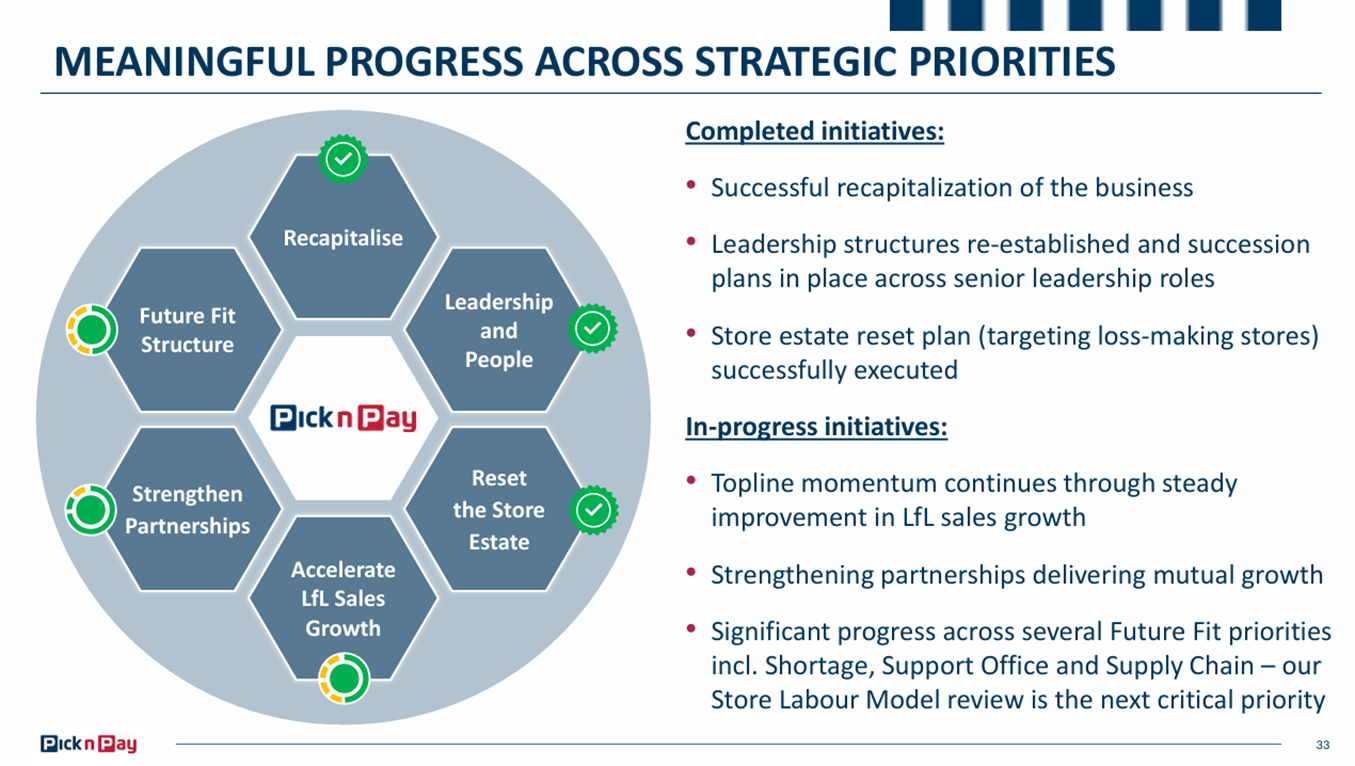
Pick n Pay FY26 Results Presentation
The strategy has been one of deliberate rationalisation. The Store Estate Reset, now described as largely complete, stripped out 98 owned and franchised stores over two years, removing 61 loss-making owned stores from the estate and avoiding close to R180m of losses in FY26 alone. Management frames this as the painful-but-necessary clearing of dead weight and says the group returns to net store growth in FY27 now that the closures are in the base.
The next, and arguably hardest, lever is labour. Prior to release of the company’s full year results, the group announced it had initiated a Section 189A consultation which “relates to certain elements of the Company’s store labour model, including scheduling flexibility and the alignment of benefits and allowances, which are not in line with market practices and peer benchmarks”. Employee costs make up over 40% of trading expenses, and Summers has long argued the business pays well above the industry norm. He was careful to stress the process is not aimed at cutting headcount per se, but the message to the market was clear: the cost base has to come down. As he put it, the group is "still in a negative jaws situation", with expenses growing faster than sales, and closing those jaws is the whole game. He likened running the business to "a complicated Swiss watch. Every cog touches another one”, a reminder that the turnaround will depend on getting many interconnected moving parts right rather than pulling a single lever.
The Boxer Lifeline: Boxing Pick n Pay Out of the Corner
Here is where the story gets interesting. Years ago, Summers bought the Boxer discount chain for roughly R180m. That business has since grown into something worth tens of billions, and it has become the parent's saving grace. Faced with a balance sheet that was, in Summers' words, upside down, the group listed Boxer in late 2024 and has recently further sold down its stake from 65.6% to 53.1%, raising an additional R4.7bn in gross proceeds in the process. Reflecting on the original listing, Summers struck a pragmatic tone. While admitting it had been "a bit sad" to list Boxer, he was clear that "it was what we had to do In order to survive."
In plain terms, management is converting the value of a thriving discount retailer into the capital needed to nurse the loss-making core back to health. Summers himself has framed the cost of the rescue as burning somewhere between R6bn and R10bn of the value created in Boxer to get Pick n Pay back to where he believes it belongs.
That raises an awkward valuation puzzle. At the time of writing, Boxer carries a market capitalisation of about R35.2bn, while the listed parent, Pick n Pay Stores, is valued at roughly R13.9bn. Yet Pick n Pay still owns 53.1% of Boxer. Do the maths and that stake is worth about R18.7bn on its own, which is around R4.8bn more than the entire parent is valued at. In other words, the market is assigning a negative value of roughly R4.8bn to everything that is Pick n Pay once you strip Boxer out.
There are a few ways to read this. One optimistic interpretation is that the core Pick n Pay business is materially undervalued, and that any credible progress to break-even may close this gap. The more sceptical interpretation is that the market is simply pricing what it sees and worrying about what lies ahead: a profitable Boxer whose value is steadily being consumed by a parent that is still burning cash, with break-even several years out. On that reading, the market may be saying it would rather own Boxer directly than watch its profits funnelled into a turnaround that keeps slipping.
The sell-down itself drew pointed questions on the call. As one analyst noted, trimming the Boxer holding means a slice of its profits is no longer consolidated, and the obvious risk is that the redeployed capital fails to earn what the forgone Boxer earnings would have. Put differently, Boxer is currently the better operation, and a smaller stake means Pick n Pay shares in that success on a smaller scale. Management's answer is that it remains comfortable as controlling shareholder at 53%, with the first priority getting the Pick n Pay segment to cash-flow break even before considering anything further.
Boxer: Landing Punches
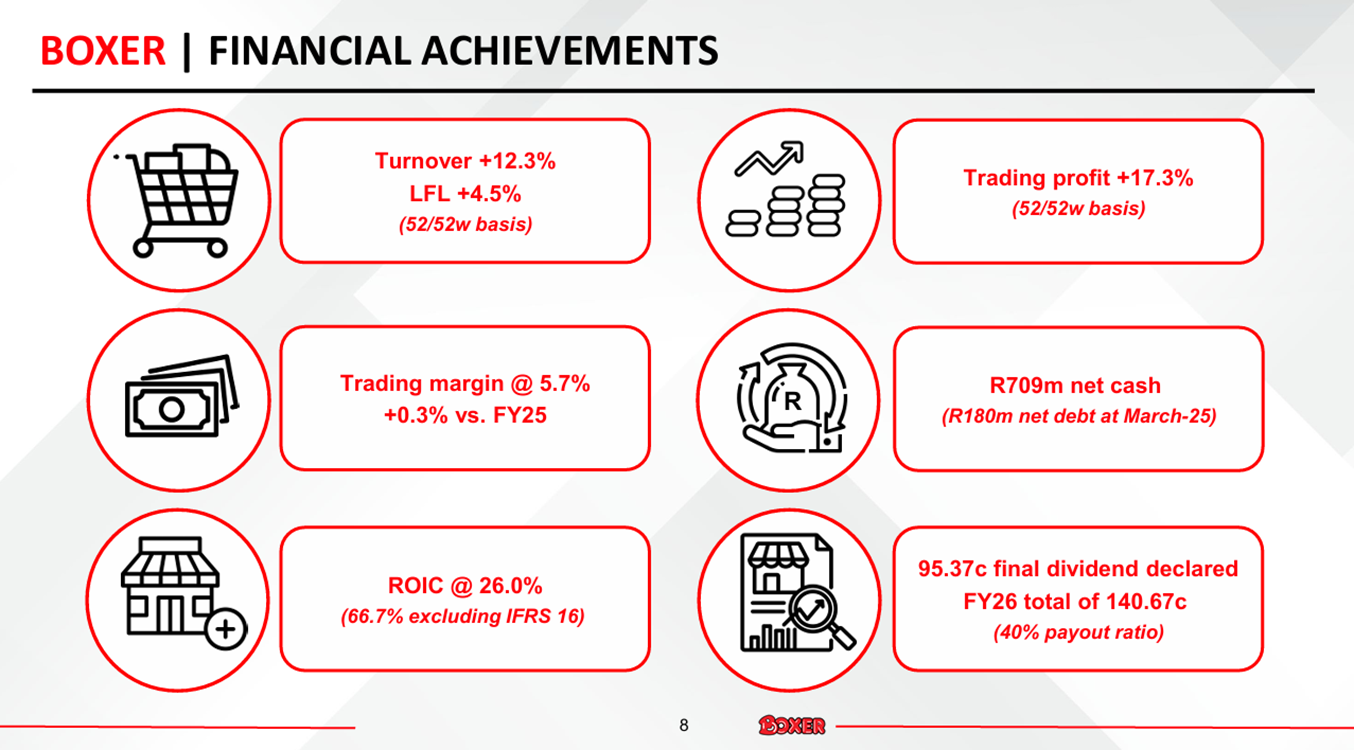
Boxer's operational performance remains exceptionally strong. Turnover grew 12.3% to R46.7bn, with like-for-like sales up 4.5% even as Boxer ran internal selling-price deflation of 1.2%. That is real growth in volumes, not price, achieved at the value end of the market where the consumer is likely most stretched. Trading profit rose 17.3%, the trading margin improved to 5.7%, return on invested capital came in at 26.0% (66.7% excluding IFRS 16 lease effects), and the business is now in a net cash position. For a discounter serving lower-LSM shoppers in a brutal economy, that is a genuinely strong performance.
However, the operating environment may well become more challenging from here. Pick n Pay’s management expects inflation to continue filtering through over the year, driven largely by higher fuel prices, with the group already flagging a meaningful step-up in monthly diesel costs. While Pick n Pay and Boxer can technically lift prices as inflation returns to defend revenue and growth, it is a double-edged sword, as Summers himself acknowledged: "it conversely then also places additional pressure on the consumer." Pushing prices onto an increasingly constrained shopper risks them simply spending less, which costs you the volume you were trying to protect.
The numbers
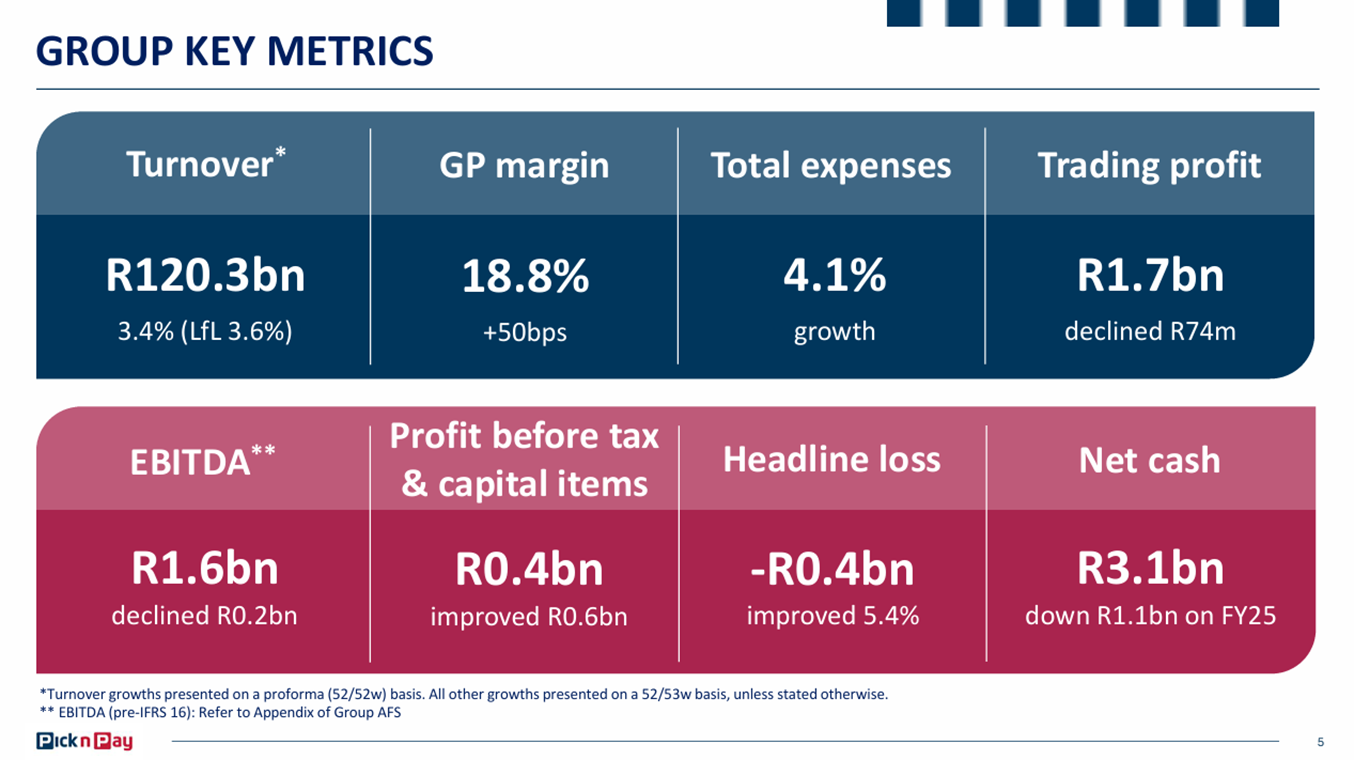
At group level, turnover reached R120.3bn, up 3.4%, while gross margin improved to 18.8%. Yet the two divisions continue to tell very different stories. Boxer once again drove growth, while reported turnover in the Pick n Pay segment declined 1.6% to R73.6bn, reflecting the impact of the store estate reset and the closure of 98 stores over the past two years. Beneath the headline number, however, trading momentum improved, with the Pick n Pay segment delivering like-for-like sales growth of 3.1%. The segment's trading loss nevertheless widened to R953m from R549m as costs continued to grow faster than sales. At group level, the headline loss narrowed 5.4% to R386m, although this was largely helped by a R681m positive net funding interest and growth from Boxer. Internal selling-price inflation at Pick n Pay was 1.9%, well below food CPI of 4.4%, reflecting management's efforts to sharpen value perceptions and win customers back.
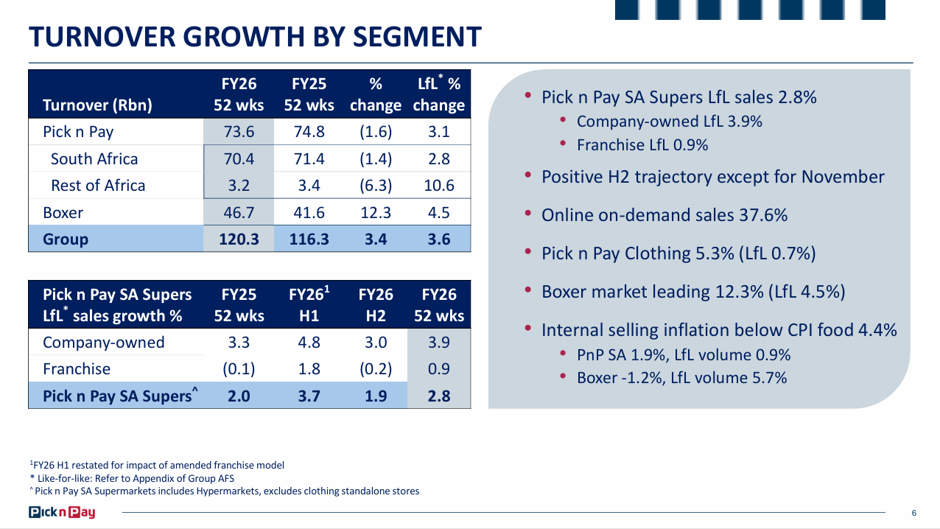
The outlook is one of cautious progress. Like-for-like sales have continued to trend higher into the new financial year after a soft November, and management remains sanguine about the eventual turnaround. But the future is far from certain. The environment may well get tougher before it gets easier, as higher energy costs feed through the system and the South African consumer's disposable income stays under pressure. Pick n Pay has bought itself time and a stronger balance sheet. Whether it can return to sustainable profitability, especially given the macroeconomic backdrop, remains to be seen.
At EasyAssetManagement, we take a thematic approach to investing, focusing on long-term structural trends that are reshaping industries and economies. As part of this strategy, we keep tabs on companies like Pick n Pay and hold a stake in Boxer in our EasyETFs Balanced Actively Managed ETF as part of our Emerging Consumer theme.
If you are looking for exposure to global equities, AI-themed opportunities, or a balanced investment strategy check out our EasyETFs Global Equity Actively Managed ETF, EasyETFs AI World Actively Managed ETF and EasyETFs Balanced Actively Managed ETF.









Any opinions, news, research, reports, analyses, prices, or other information contained within this research is provided by an employee of EasyEquities an authorised FSP (FSP no 22588) as general market commentary and does not constitute investment advice for the purposes of the Financial Advisory and Intermediary Services Act, 2002. First World Trader (Pty) Ltd t/a EasyEquities (“EasyEquities”) does not warrant the correctness, accuracy, timeliness, reliability or completeness of any information (i) contained within this research and (ii) received from third party data providers. You must rely solely upon your own judgment in all aspects of your investment and/or trading decisions and all investments and/or trades are made at your own risk. EasyEquities (including any of their employees) will not accept any liability for any direct or indirect loss or damage, including without limitation, any loss of profit, which may arise directly or indirectly from use of or reliance on the market commentary. The content contained within is subject to change at any time without notice.
Search all articles
Posts by topic
- Market News & Events
- Easy Community
- Education
- Dividends Update
- Exchange Traded Funds (ETFs)
- Property Investing
- Managed Bundles
- USD Wallet
- Retirement Annuity (RA)
- Cryptocurrency
- Tax Free Savings Account (TFSA)
- International Investing
- Unit Trusts
- New to Investing
- Artificial Intelligence
- EasyProtect
- EasyCredit
- Shares
- Government Bonds
- New Listings