
Commodities are basic raw materials such as metals, energy resources, and agricultural products that underpin everyday life and modern technology.
From copper used in electronics to lithium in batteries and steel in infrastructure, commodities drive innovation, support economic growth, and create wealth by generating value across supply chains and investment opportunities.
UBS Global, a leading wealth management firm, says commodities will play a bigger role in portfolios in 2026. “Our forecasts point to attractive returns, supported by supply-demand imbalances, geopolitical risks, and the global energy transition,” with opportunities in copper, aluminum, and agriculture, while gold remains a key diversifier.
Investing In Commodities
Investors often use mining companies to gain exposure to commodity supply and demand, as these businesses sit at the heart of the real economy.
Mining companies generally fall into three broad categories:
- Explorers/Junior Miners are early-stage companies focused on discovering new mineral deposits. They offer high growth potential but come with higher risk. For example, in the copper and gold sector:
- Orion Minerals aims to revive the Northern Cape’s copper mining industry through its Prieska Copper-Zinc Project.
- West Wits Mining is another example, having recently opened South Africa’s first new gold mine in more than a decade.
- Mid-tier miners are established producers with operating mines. They sit between junior and major miners and typically have proven assets and revenue streams. Examples include:
- DRDGold Limited, a gold miner in the local market
- Sandfire Resources Limited, an Australian mid-tier copper-gold producer.
- Major, or giant, miners are large, diversified companies with global operations. They often deliver more consistent earnings and dividends across commodity cycles. These include mining giants operating across multiple jurisdictions, such as:
- BHP Group, one of the world’s largest mining companies with exposure to iron ore, copper, and potash
- Rio Tinto, a globally renowned miner known for iron ore, with major iron ore, copper, aluminium, and critical minerals operations.
- Sociedad Química y Minera de Chile (SQM) and Albemarle Corporation are also key players, as two of Chile’s main lithium producers and major participants in the global lithium market.
While mining companies are listed across most global markets, their profiles differ by region. Australia is known for hosting a wide spectrum of mining companies, from explorers to global mining giants; the American and South African markets are more heavily weighted toward mid-tier and established miners with operating assets and relatively stable cash flows. When it comes to dividends, mid-tier and major miners are also more likely to pay regular dividends compared to junior miners.
Commodity Prices, Profits and Shareholder Returns
When demand for commodities such as gold, iron ore, copper, coal, or platinum rises, mining companies are often among the first to feel the impact through higher revenues, particularly when supply struggles to keep pace.
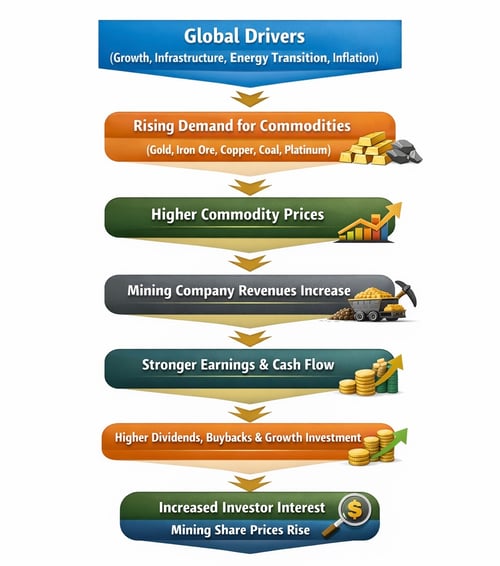
Disclaimer: This illustration is for educational purposes only and shows one possible scenario. Commodity prices, company earnings, and share prices are volatile and influenced by many factors. Outcomes are not guaranteed and actual results may differ materially. Capital is at risk. This content does not constitute financial advice or a recommendation to invest
This direct link to physical resources makes mining stocks a popular choice for investors seeking exposure to global growth trends, infrastructure spending, energy transitions, or inflationary environments.
One of the key attractions of mining companies is their ability to return value to shareholders through dividends, share buybacks, and capital gains. During periods of strong commodity prices, mining companies often generate excess cash, which can be used to increase dividends or repurchase shares.
Share buybacks reduce the number of shares in issue, improving earnings per share (EPS) in the long term, while dividends provide investors with regular income. Rising EPS and dividend growth often attract investor interest, supporting higher share prices over time.
Commodity prices play a central role in driving mining shares by influencing profitability. Higher prices generally increase revenue and margins, boost EPS, and make stocks more attractive, often resulting in capital gains.
Examples
- Previously, supported by higher precious metal prices, Fresnillo, a leading Mexican gold producer listed in the UK market, announced both an ordinary and a special cash dividend. Its shares are up more than 400% over the past 12 months.
- For junior miners, rising gold prices can improve access to funding, increase investor interest, and make them potential takeover targets. West Wits Mining is an example, with its shares up around 800% over the past 12 months.

Corporate Actions: Mergers, Acquisitions and Value Unlocking
Rising commodity prices and increased focus on the real economy can also trigger corporate actions within the mining sector. Strong market conditions often encourage mergers and acquisitions, as larger players seek to acquire quality assets or smaller competitors to expand reserves and production. In some cases, companies pursue demergers to unlock value by separating different commodities or geographic operations, allowing investors to better value each business based on its specific risk and growth profile.
Anglo American is a good example of this trend. As one of the world’s leading mining companies, it has been reshaping its commodity focus, resulting in spin-offs as well as mergers and acquisitions while Glencore has confirmed early-stage discussions with Rio Tinto over a potential all-share merger that could involve some or all of its businesses.


For investors, these corporate actions may lead to cash payouts or receiving shares in the acquiring or newly formed company. Takeovers may offer cash, shares, or a combination of both, while demergers could provide shares in the separated business, potentially unlocking additional value.
Geopolitics, Policy and Resource Security
In recent months, there has also been growing global attention on access to critical mineral resources, with major economies increasingly prioritising resource security to support economic growth and technological development.
While (P) policymakers play a significant role in the allocation and regulation of natural resources, other aspects such as Economic, Social, Technological, Legal, and Environmental (ESTLE) dynamics, along with consumer demand, also influence the outlook for mining companies, reflecting the full PESTLE framework.
Conclusion
The commodity market is often considered volatile; however, investors may benefit from mining companies that diversify across multiple commodities and operate in different jurisdictions. This diversification reduces reliance on a single market or regulatory environment and positions companies to capture long-term global demand trends.
As part of events such as dividends from mining companies, it's often that no action is required from investors beyond owning the shares until the close of the last trading date.
Beyond individual mining companies, exchange-traded funds could offer an alternative approach, as they typically invest in more than one mining company or the commodity itself. This provides diversification and reduces exposure to company-specific operational risks.
*Past performance is not indicative of future returns. All investments carry risk, and outcomes may vary depending on market conditions and individual circumstances.
Sources – EasyEquities.
Author: Cay-Low Mbedzi


.png?width=1200&length=1200&name=image%20(117).png)
.png?width=1200&length=1200&name=image%20(119).png)
Any opinions, news, research, reports, analyses, prices, or other information contained within this research is provided by an employee of EasyEquities an authorised FSP (FSP no 22588) as general market commentary and does not constitute investment advice for the purposes of the Financial Advisory and Intermediary Services Act, 2002. First World Trader (Pty) Ltd t/a EasyEquities (“EasyEquities”) does not warrant the correctness, accuracy, timeliness, reliability or completeness of any information (i) contained within this research and (ii) received from third party data providers. You must rely solely upon your own judgment in all aspects of your investment and/or trading decisions and all investments and/or trades are made at your own risk. EasyEquities (including any of their employees) will not accept any liability for any direct or indirect loss or damage, including without limitation, any loss of profit, which may arise directly or indirectly from use of or reliance on the market commentary. The content contained within is subject to change at any time without notice. Past performance is not indicative of future results.
Search all articles
Posts by topic
- Market News & Events
- Easy Community
- Education
- Dividends Update
- Exchange Traded Funds (ETFs)
- Property Investing
- Managed Bundles
- USD Wallet
- Retirement Annuity (RA)
- Cryptocurrency
- Tax Free Savings Account (TFSA)
- International Investing
- Unit Trusts
- New to Investing
- Artificial Intelligence
- EasyProtect
- EasyCredit
- Shares
- Government Bonds
- New Listings